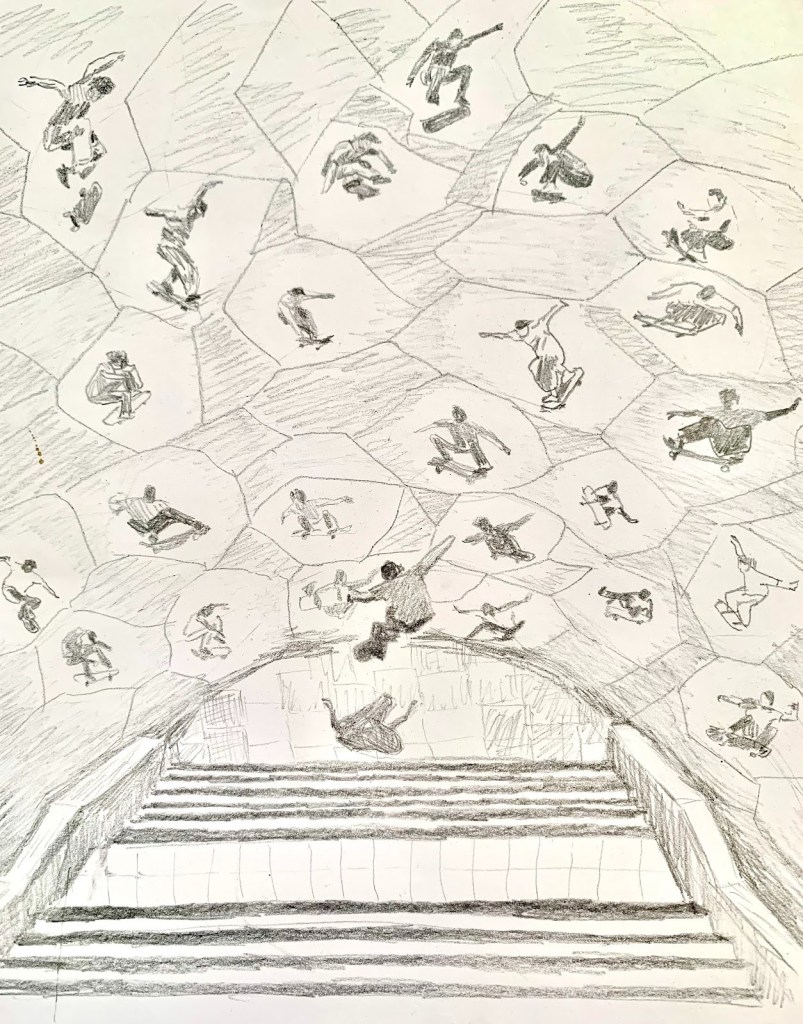
This sketch is titled Eye of the Storm. At the center of the image, a skateboarder jumps down a long flight of stairs and is suspended before a painful fall or successful landing. This moment of crossing, between the risk and reward of becoming or failing, is heightened by his being at the center of a tornado. The tornado is not chaos but a moment of stillness and concentration while the storm spins ferociously around him. The tornado is showing mirrored reflections of himself, slightly imperfect and spontaneous, at slightly imperfect angles to capture a cubist-like real representation of the world and angles from within the drawing. In cubist tradition, the angles do not capture accurate external angles but relative interior angles, many points of view, sometimes contradictory, of the same subject. The reflections are not only mirror images of himself, but of other skateboarders also. When looking closely, their clothes and positions are slightly different. The reflections are not perfect mirrors of the subject. In skateboarding, imperfections in our online representations are tolerated, much like bruises and falls are tolerated.
On social media, the images have another interpretation where they are also portals to another skater’s social media post or profile. This reflects how skate images as physical, somatic expressions of value get circulated through reblogs and reposts. It is a reflection on modern skate culture and its punk rebellion applied to social media.
Social media, known for being a competitive, superficial hyperreality, where symbols have become so abstract they no longer bear resemblance to reality. For example, the Louis Vuitton logo. The generation of the advent of facebook understands what damage social media had irreparably done to the social fabric, to the quantified approach it brought to our intangible relationships to each other and to ourselves with the atomic-bomb impact of the ‘like’ button. However, as in this drawing, the shared somatic expressions between members of the online skate community do not reflect the same kind of damage and disconnection.
Much as writing and art is a form of psychic survival, skateboarding is a form of somatic continuity and integration despite risk and violence. It allows the body to articulate its values of survival and so helps its participants maintain bodily function and coordination, even breathing, nervous system regulation through life events that can disorganize a person. In sharing these somatic expressions, a community creates a shared movement of the ideal, ‘safe’ body, just as writing creates a continuation of cognitive sanity.
In the reflections of other skaters doing variations of the similar pose, there is less comparison and more resonance in social connection building through shared and mirrored movement. Under capitalist patriarchal society, boys lack true masculine initiation rituals in places and are instead replaced with pseudo-masculine rituals such as the army or gangs. Skateboarding is one of those places where boys attempt rituals to become men. In many traditions, pre-capitalist around the world, this was marked by the presence of elder males, physical risk, symbolic death rebirth, interiorized community, and the absence of females. (King, Warrior, Magician, Lover, Moore, Robert). There may not be a strict absence of female participants but there is an absence of femininity, but not as a rejection but as a focused psychic space free of distractions during a risky life period. This drawing invites contemplation in what way skate culture has overcome or failed as a true masculine initiation. And also, if it is possible to renew such masculine rituals in the modern world.


Leave a Reply