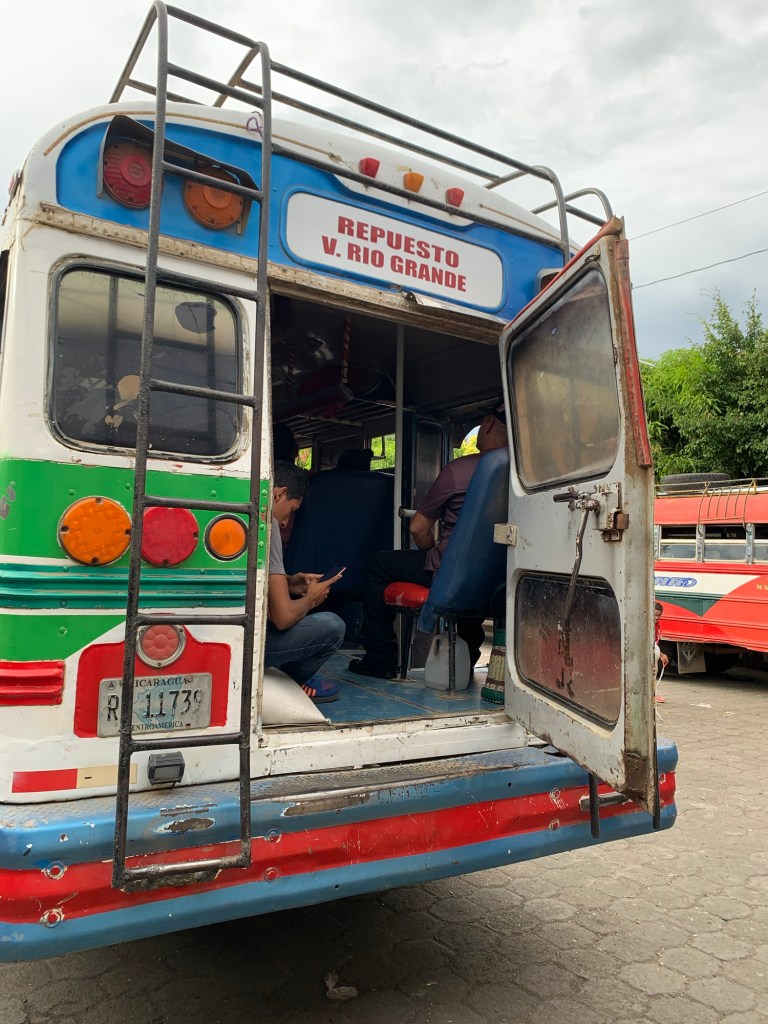
The border in Spanish is called La Frontera. This is possibly my favorite word. I wish I could say ‘I’m going to the frontier’ in casual language the way I can say it in Spanish. It sounds like I am going to the frontiers of spacetime. Today I crossed the border from Costa Rica into Nicaragua at penas blancas. I woke up at 4am and started the day early by taking buses from Nosara to Santa Cruz to Liberia and finally to the border, then onward to Rivas.
Costa Rica and Nicaragua are neighbours but vastly different economically. I am learning and practicing my Spanish. I am learning about tone and local dialect, not just slang but different emotional tones. What Costa Rica and Nicaragua surprisingly have in common is emotional restraint. I say surprisingly because most of Latin America is known for the opposite of restraint.
When I crossed the border from Costa Rica to Nicaragua today, I felt how that restraint changed in tone and meaning. In Costa Rica it came from a luxury or pride in not having to express oneself openly, the luxury of time, of things working out, of someone else taking care of it. Then the same restraint went underground, transforming into something harder. It became a necessity and survival. Being unrestrained was dangerous. I kept everything inside since the beginning, not speaking to anyone, just thinking to myself and watching the landscape go by. The reasons I kept things to myself started to feel heavier and more difficult. The things I left unsaid, I still couldn’t say, grew more urgent, more painful, more dangerous. The things I didn’t say so I wouldn’t hurt anyone, I slowly realized that they were hurting me. I solemnly promised myself, to never get hurt again. I thought long and hard about what really mattered to us now. We will protect what’s left, what will never be lost again.
The higher price of Nicaraguan consciousness means I can face the truths that seemed to elude me before. Here, the cost of American Imperialism is clear and open, they resist in silence, but they do resist. There is no confusion. You can see what that has cost them, that clarity. You see how it has devastated the country, both physically and spiritually. But at least it is clear. In Costa Rica sometimes I get afraid and I don’t know what I’m afraid of. I look around and everyone is at a party and having a good time. I look at my life and everything seems fine.
They never go into the nuances of it, it’s avoided, deflected, gently set aside when you come home and picked back up the next morning on your way out the door. The smiles and hospitality you wear for the tourists you don’t know and who don’t know you. People who pretend to be like you but never will be. You hold their illusions gently like an iridescent soap bubble. You tell them the world is as hopeful and beautiful as they say it is. You smile warmly when they talk about world peace and sell them a postcard of paradise. You pretend for them, pretend for the things they don’t want to know about themselves. You clean up the dust on their villa kitchen but not the dust on your own table. The pretending too, never gets cleaned up. It gets all over your friends and family. It gets all over your clothes and your hair.
The city of Rivas is my first stop. It is busy and I get busy too, busy finding an ATM and immediately go on a shopping spree, lured by the prices that are a fraction of those in Costa Rica. Two of the women in the department store shyly ask for my Instagram because they’ve never met a Korean and they want to be friends. I smile and say we can be pen pals. By the time I get on the bus to San Juan, it’s 5 in the evening. I sleepily watch the sunset, a pink and crimson spectacle over the plain countryside. A cloud looks distinctly like a heart and the sun sets directly behind it, refracting rays of brilliant light all around. It is completely dark when I arrive and I am somewhere much beyond sleepy and tired. I no longer know where the energy in my body is coming from.
The older woman who runs the hostel at San Juan del Sur is chatting with the ice cream server, sitting on wide lip of a concrete plant pot on the street. The hostel is called ‘the Kiss rooms’ and the adjacent ice cream store is called ‘kiss me ice cream.’ When I think back now it’s a surprisingly affectionate name, and not one that would exist in Costa Rica. Too close, too uncomfortable.
She recognized me when I stumbled past. From her tense expression, I worried she had waited too long. But I remembered I’d given her a fairly accurate estimate. She looked American, around 60. She was commanding, energetic, and sharp. Combined with the authority of her age, I found her intimidating in a way I rarely am. She greeted me in Spanish. My Spanish was good enough to check in. However, I was so tired from travelling since 4am (it was now past 6 in the evening) that it took me longer than usual to form sentences. Apparently not fast enough. ‘So you can’t speak Spanish?’ She snapped at me.
She spoke to me with an urgent tone that startled me. ‘Did you read the manual?’ She asked. At least I think she said ‘manual.’ I was bewildered, was there some problem? Did I make a mistake?
’this is the hot room.’
Even if I understood Spanish that didn’t make any sense. I stared at her blankly.
‘It has no air conditioning.’ She pointed to the two fans. One was plugged in above the bed, and a second one was next to the door. There was no apparent outlet for it I noticed.
I nodded that I understood. I said it was fine. ‘Está bien, está bien’ I said in response to everything she showed me, apparently in self-defense. She explained to me how there were two doors, one with a screen. This is for the heat she explained. The room had no windows as well. I said the fan was fine. I said I’m used to the heat and that I’ve lived in Costa Rica for four years. She interrupted me by explaining how the fans are sufficiently cool.
When she was done, she grumpily said that it was her dinner time and she was missing it because she was waiting for me, and stormed out with a jingle of her keys.
I collapsed in the bed even more exhausted from the rude interaction. This would never happen in Costa Rica. I kept wondering why this woman hated me for no reason. I kept trying not to let the anger bother me. I hate not knowing the reason for things. I made up my mind to give her justice in the review. I will describe her attitude accurately and not give too low a review but I will carefully explain why I didn’t give her five stars. Yes, that’s the solution.
The next morning she greeted me with genuine warmth and asked me how I slept. She was eating a pastry and happily sipping her coffee in the corner of the kitchen. Throughout the next four days her attitude fluctuated, seemingly based on her own rhythm of life, and not dictated by the social contract of host and guest. When I think back now, it simply never occurred to her to pretend to feel anything other than how she was feeling. It would also explain why my insistence on the fans being fine didn’t land with her, she wasn’t buying my politeness, she wanted to know how I really felt.
A fairly unremarkable quality in a person, but all the same, this is the sort of experience that would be impossible to have in Costa Rica. I think what surprised me the most is the bubble I had been in while living in Costa Rica. I started to think this polite pretending was the only way to act. I sensed a cultural superiority and stubbornness here. I sensed in Nicaragua I could openly comment on the cultural differences, and they would be self aware of their own frankness. But this is not a conversation I would ever be able to have in Costa Rica. I would never be allowed to say ‘you are pretending.’ They would simply not allow it. I wouldn’t be able to talk about the frankness in Nicaragua. ‘Well they are Nicas’ they would probably respond, or some variant of the regional racism.
Ticos are taught to prioritize hospitality to foreigners from an early age, and it is an integral part of their school curriculum. Even my Costa Rican friends who are reading this, will still have to perform their reactions to this piece. Even interacting with friends requires emotional labor because their livelihoods depend on it. But it seems like Nicaraguans don’t have that same dependency, even though they have much less income and much less opportunities for wealth. But all the same, when it comes down to actual social interactions and emotional labor, it’s simply something that they don’t have to carry. It shows that when it comes to participating in the American Empire, there is a real cost to opting in and there is a benefit to opting out.

 SUBLIME COURAGE
Leave a comment